
Integrated Thermal Management Applications
Thermal Energy Storage (TES):
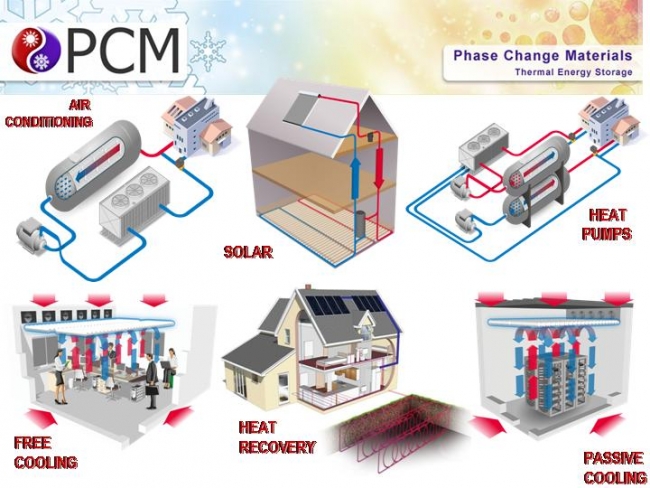
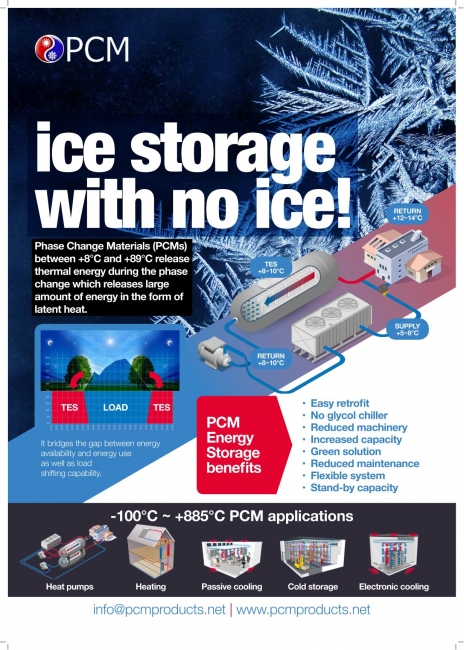
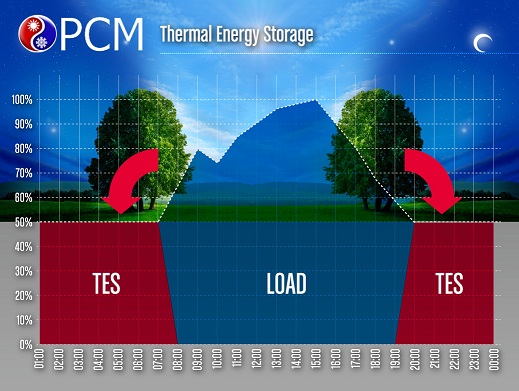
Thermal Energy Storage is the temporary storage of high or low temperature energy for later use, bridging the gap between requirement and energy use. The storage cycle might be daily, weekly or seasonal depending on the system design requirements, and whilst the output will always be thermal, the input may be thermal or electrical.
- Reduced Running Cost - load shifting provides reliable operation and lower annual electricity/energy running costs.
- Reduced Machinery - shifting some of the peak load may enable designers to reduce the main machine size.
-
Increased Capacity - as a retrofit application, the additional TES load may increase the system output
without any additional machinery. -
Green Solution - reduced machinery size means reduced energy consumption, giving lower direct
and indirect CO2 emissions. - Flexible System - the overall machinery capacity and TES capacity can be exactly matched to system loads.
-
Stand-By Capacity - in case the main machinery fails, the stored energy can be utilised to handle the
system loads, thereby providing a degree of back-up facility.
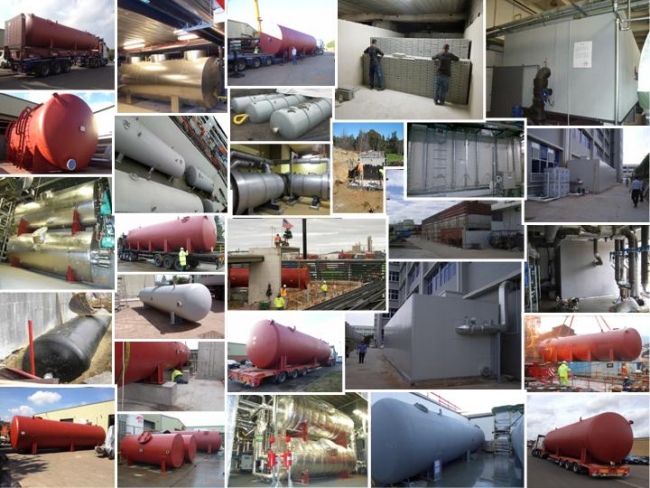
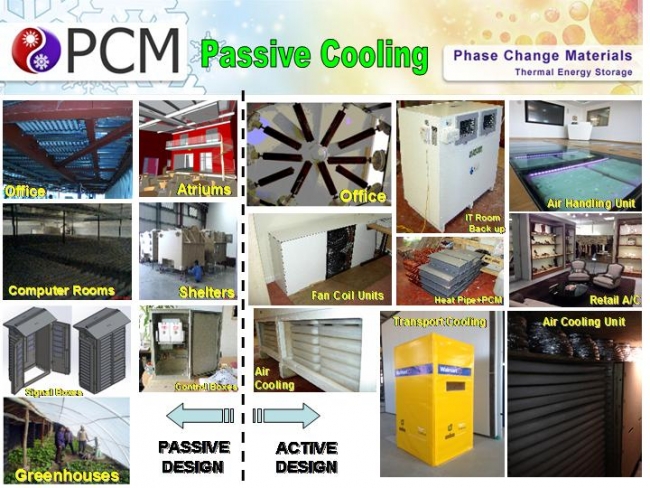
PCM Global Application Examples (2.0 MB)

Phase Change Materials (PCMs)
Phase Change Materials, commonly referred to as PCMs, are products that store and release thermal energy during the processes of melting and freezing. Phase Change Materials release large amounts of energy upon freezing in the form of latent heat but absorb equal amounts of energy from the immediate environment upon melting. This enables thermal energy storage; heat or coolness being stored from one process or period of time and used at a later point in time or transferred to a different location. PCMs can also be used to provide thermal barriers or insulation, particularly useful for industry sectors such as temperature-controlled transport.
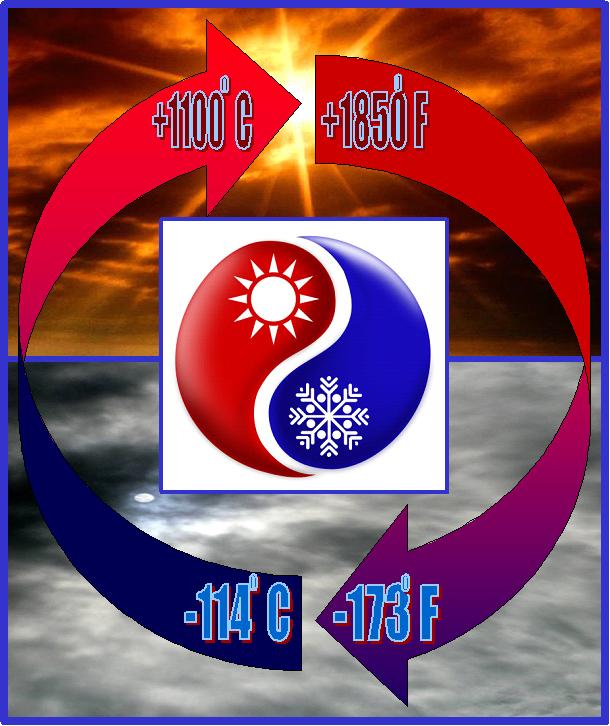
Interestingly, the simplest, cheapest and most effective Phase Change Material is water/ice. Unfortunately, its freezing point of 0°C (+32°F) precludes it from the majority of energy storage applications. However, a number of alternative Phase Change Materials have been identified and developed that freeze and melt like water/ice, but at temperatures from the cryogenic range to several hundred degrees centigrade.
The PlusICE range is arranged into three categories:
- Eutectics- solutions of salts in water or alternatively non-water based solutions with a phase change temperature below 0°C (+32°F)
- Salt Hydrates - specific salts able to incorporate water of crystallisation during the freezing process, normally above 0°C (+32°F)
- Organic Materials - which tend to be polymers composed primarily of carbon and hydrogen. These mostly change phase above 0°C (+32°F) and can be as simple as coconut oil, waxes or fatty acids.
- Solid-Solid - A specialised group of PCMs that undergo a solid/solid phase transition with the associated absorption and release of large amounts of heat. These materials change their crystalline structure from one lattice configuration to another at a fixed and well-defined temperature, and the transformation can involve latent heats comparable to the most effective solid/liquid PCMs.a range of solutionsfrom +25°C (77°F) upto +180°C (356°F).
Applications
Our PlusICE range of products including FlatICE, BallICE, TubeICE, Eutectic Plates and Pouches enables us to develop and apply both organic and hydrated salt based PCMs for a variety of applications around the world.
Positive Temperature PCM Applications
- Chilled Food Transport
- Drink Cooling
- Drink Vending
- Medicine & Vaccine Transport
- Air Conditioning
- Building Passive Cooling
- Water Heating
- Solar Heating
- Waste Heat Storage
- Heat Rejection Systems
- Telecommunication Shelter Cooling
- Electronic / Battery Cooling
- Co-Generation / TriGen Systems
- Heat Pumps
Negative Temperature PCM Applications
- Temperature Controlled Packaging
- Frozen Food Transportation
- Ice Cream Vending
- Medicine & Vaccine Transport
- Food Stall Cooling
- Automotive Cooling Applications
- Marine Refrigeration
- Cold Store Back-up
- Transport Refrigeration
- Body Cooling
- Medical Passive Cooling
- Temperature Controlled Transport
- Cryogenic Back up
- Refrigerator Energy Saving
Read More...
Temperature Controlled Distribution
Building Temperature Control Services
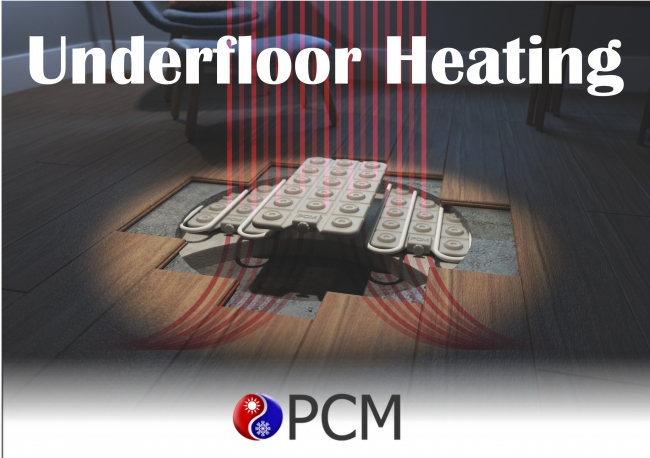
Solar Heat Storage
Passive Enclosure Cooling
Thermal Barrier Applications
Product & Application Development